The global food system currently operates under a massive contradiction. Millions of people face daily food insecurity. Yet, staggering volumes of food are lost at every stage of the supply chain. If commercial operations want to build resilient businesses, they must learn how to reduce food waste retail models aggressively. We must stop this loss before inventory hits municipal landfills.
At THAIFEX – Anuga Asia 2026, the global industry gathered at an unprecedented scale. The event spanned 12 exhibition halls and 140,000 square meters of innovation. It brought together 3,590 exhibitors from 56 countries and 94,685 international visitors.
During an execution-focused panel session titled “From Data to Action: A Practical Roadmap to Reduce Food Waste for Manufacturers & Retailers,” Marco Sandri, Global Manager of The PLEDGE on Food Waste, met with industry leaders to map out an actionable framework. The panel featured sustainability champion Andrea Bellini (Lightblue), Dr. Phontakorn Wongcharoen (Betagro Group/Thai Future Food Trade Association), and Siriporn Dechsingha (CP AXTRA PUBLIC COMPANY LIMITED).
Here is the operational roadmap established during the event.

1. The Global Paradox vs. Thailand’s Local Reality
To understand why commercial operations must prioritize food waste mitigation, we have to contrast the global baseline with localized data. According to recent UN data, the world wastes roughly 1.05 billion tonnes of food annually (rising to 1.8 billion tonnes when factoring in post-harvest supply chain losses). If global food waste were a nation, it would rank as the third-largest greenhouse gas emitter on Earth.
When evaluating where downstream waste occurs post-retail, global baselines attribute:
- 60% to Households
- 28% to Commercial Food Service (Hospitality, Events, Restaurants)
- 12% to the Retail Industry
The Local Crisis: Thailand’s 39% Benchmark
While a 12% global footprint makes retail seem like a minor piece of the pie, its strategic positioning is massive. Retail procurement dictates upstream farmer behavior and directly influences downstream consumer habits.
In Thailand, this challenge is acutely localized. Data from the Ministry of Natural Resources and Environment (MNRE) reveals that 39% of Thailand’s entire national waste stream is food waste.
This amounts to 9.68 million tons annually, translating to an average of 146 kilograms of food waste per person, per year. In a nation structurally defined by its agricultural heritage and world-class gastronomy, throwing away 146 kg per capita represents a catastrophic economic leakage and an urgent ESG threat.
2. Intercepting the Value Chain: The High-Leverage Points
According to value chain benchmark data from the Boston Consulting Group (BCG), food volume bleeds steadily from farm to fork:
[Production: -13%] ──> [Storage/Transport: -6%] ──> [Distribution/Retail: -6%] ──> [Consumer: -8%]
By the time food reaches final consumption, the system suffers a cumulative 34% loss. To effectively reduce food waste retail businesses and distributors cannot simply tell households to waste less. They must intercept the middle of the value chain.
By targeting commercial food service (the 28% global footprint) and grocery retail (the 12% footprint) through automated monitoring, smart inventory forecasting, and rigid circular protocols, the industry can capture that 34% systemic loss before it ever hits a consumer’s home.
3. Shifting from Luxury Hospitality to Supermarket Floors
A major point of discussion during the THAIFEX panel was how food waste mechanics change across different business models. Lightblue has built an international reputation helping 5-star luxury hotels and resorts slash waste through granular operational tracking. However, moving from a luxury resort to a commercial supermarket floor changes the rules completely. This is a structural shift from Dynamic Craftsmanship to Static Volume.
- The 5-Star Hotel Environment: Waste here is live, behavioral, and unpredictable. It is driven by unexpected guest numbers, over-preparing for lavish buffets, and precision trim waste during complex kitchen prep. Resolving it requires shifting kitchen team cultures and adjusting menus in real time.
- The Grocery Retail Environment: Supermarkets do not cook; they move massive inventory. Their waste profiles are dictated by static volumes, rigid shelf-life parameters, and corporate procurement strategies.
Overcoming the “Dashboard Trap”
Modern supermarkets face a unique obstacle known as the Dashboard Trap. They possess robust enterprise systems that tell them exactly what expired, when, and where (e.g., “40 kg of organic avocados expired in Aisle 4”). However, big data frequently leaves a total blind spot regarding the “Why.”
To truly solve waste, an operator must ask:
- Did those avocados expire because corporate procurement mandated an unrealistic Minimum Order Quantity (MOQ)?
- Did the regional cold chain fail in the intense local climate, stripping 48 hours off the item’s shelf life before it reached the store?
- Did the store manager over-stack a giant, “eye-candy” display because a corporate policy dictates that shelves must always look hyper-full to drive customer purchases?
Data without human, operational context is just noise. Supermarkets must implement a diagnostic layer to distinguish between Operational Waste (floor handling and display standards) and Demand Waste (forecasting and purchasing errors at headquarters).
4. Three Steps to a Circular Retail Model
To move past traditional inventory loss and achieve a verifiable “Zero Waste to Landfill” target, retailers should adopt a three-step operational roadmap:
1.Move Beyond the Reduced-to-Clear (RTC) Stage: Immediate Priority.
Do not rely entirely on yellow discount stickers slapped onto fresh food a few hours before expiration. That fixes symptoms rather than the root cause. Consistent clearance indicates a broken procurement model. Retailers must leverage real-time floor data to transition to Dynamic Ordering, aligning central buying logic with daily shop-floor realities.
2.Empower and Gamify the Branch Level: Operational Integration.
Prevention happens on the supermarket floor, not inside corporate headquarters. Retailers must shift from basic inventory tracking to active Process Tracking by training floor staff to log the exact reasons waste occurs. Build an internal culture of accountability by gamifying floor teams and turning department managers into certified Waste Champions. Additionally, eliminate the practice of over-stacking fresh produce—which structurally crushes and spoils food at the bottom—and adopt dynamic, data-driven pricing algorithms that apply micro-discounts based on real-time foot traffic and remaining shelf life.
3.Build a Localized Circular Network: Ecosystem Collaboration.
Inevitable organic waste cannot be eliminated in isolation; it requires a dedicated, localized ecosystem. Retailers can immediately plug into ready-to-use networks across four distinct tiers:
- Food Rescue NGOs: Connect safe, surplus food to direct donation pipelines with established groups like Scholars of Sustenance (SOS Thailand), WWF Thailand, or the BKK Food Bank to feed vulnerable local communities.
- Surplus Distribution Apps: Monetize close-to-expiry inventory by partnering with commercial tech platforms like Yindii or localized sharing apps like Olio to capture eco-conscious, deal-seeking consumers.
- Upcycling & Biotech Transformation: For food no longer fit for human consumption, partner with biotech innovators. Firms like Flylab utilize Black Soldier Fly larvae to turn organic waste into high-quality insect protein. Others, like More Meat and WarmHeart, focus on plant-based and community-led transformations, while commercial hardware like Oklin allows for rapid, on-site composting.
- Animal Feed Routing: Route clean organic scraps—such as bakery surplus or bruised produce—directly to local pig and poultry farms in neighboring provinces, completely bypassing municipal landfills while lowering commercial disposal costs.
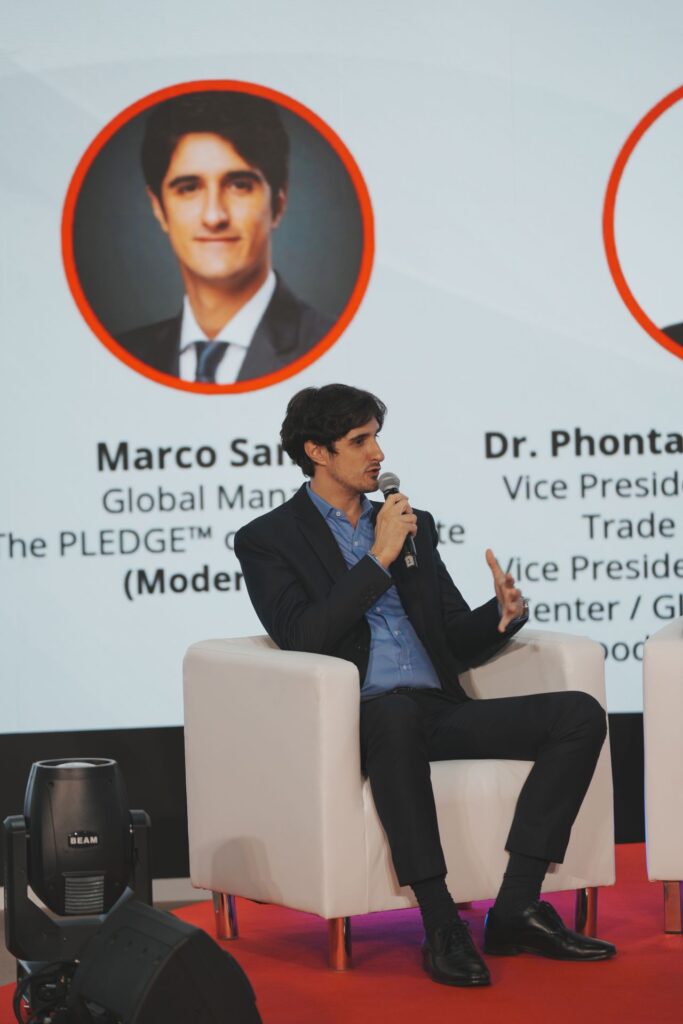
“Reducing food waste is not only about better data or isolated operational improvements, but about building stronger collaboration across the supply chain. Manufacturers, retailers, and solution providers need shared visibility, shared responsibility, and shared action.”
— Marco Sandri, Global Manager of The PLEDGE on Food Waste
True change within the global food system requires moving past abstract sustainability theories and adopting rigorous, auditable operational standards. In an industry where one-third of all food is lost, supply chain excellence is no longer optional—it is a business imperative.
Is your retail, hospitality, or food service operation ready to move beyond the “Dashboard Trap” and implement real, auditable change? Read more about how EU Empowering Consumers Directive EmpCo: Stop Greenwashing Now